
I am writing to you today with some important information about Real Estate parkland. This is an area that has been under attack from many directions lately, so I thought it was time for me to put together some facts and figures on this topic. Please note that my sources are all reputable professionals who have experience dealing with this issue.
Before we get into the details, let's talk about what land use policy in Florida means.
There are two types of land uses allowed on any given parcel of property: residential and non-residential.
- Residential uses include single-family homes (houses), condominiums or apartment buildings, as well as businesses such as hotels and motels.
- Non-residential uses include commercial office space, industrial buildings, and other structures not used primarily for business purposes.
There are three main categories of land use policies in Real Estate Parkland:
1. Conditional Use Permit,

2. Mandatory Use Permit and
3. Limited Public Property.
All three types of permits can be obtained by either the owner or the developer/owner.
There is no difference between these three permit types; they all allow the same type of use at the same location.
- Conditional use permits are given when no adverse effects can be shown by granting the permit. If the proposed use is contrary to any of the criteria in the land use regulations, a conditional use permit would not likely be given.
- Mandatory use permits are also called negative determinations and are used when it can be shown that there will be no adverse effects if the proposed use is granted at that location.
- Limited public property is for government-owned land. Since government-owned land is not subject to market forces, it does not matter how much a parcel of land is worth; if the local government wants to keep it open as a park, no private company would be able to build on that site.
There are five things you should know about real estate parkland property in Florida.
These five points will help you to make an informed decision on whether or not to purchase this type of land.
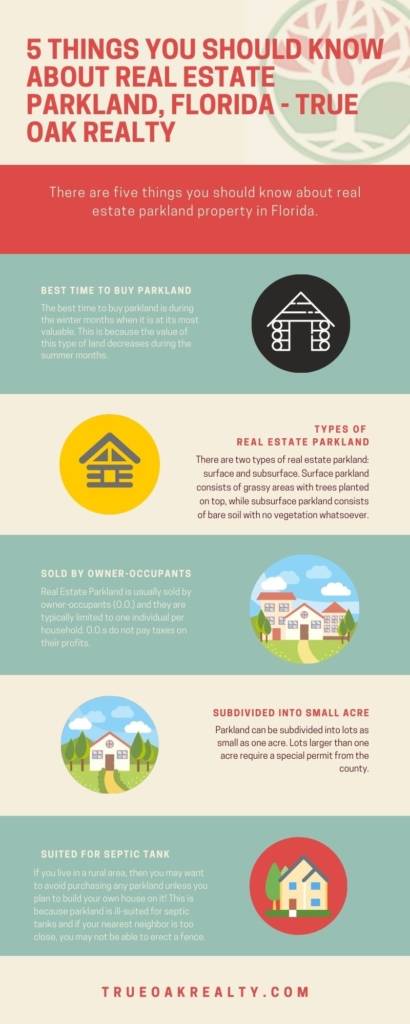
1) The best time to buy parkland is during the winter months when it is at its most valuable. This is because the value of this type of land decreases during the summer months.
2) There are two types of real estate parkland: surface and subsurface. Surface parkland consists of grassy areas with trees planted on top, while subsurface parkland consists of bare soil with no vegetation whatsoever.
3) Real Estate Parkland is usually sold by owner-occupants (O.O.) and they are typically limited to one individual per household. O.O.s do not pay taxes on their profits.
4) Parkland can be subdivided into lots as small as one acre. Lots larger than one acre require a special permit from the county.
5) If you live in a rural area, then you may want to avoid purchasing any parkland unless you plan to build your own house on it! This is because parkland is ill-suited for septic tanks and if your nearest neighbor is too close, you may not be able to erect a fence.
Now that we have those preliminaries out of the way, let's discuss how to incorporate real estate parkland into your personalized investment strategy.
Pros and Cons
When I first saw this option available to me, I was a little hesitant about it because; like anything else, there are pros and cons to doing it. Since it would be unreasonable to list every advantage and disadvantage, I'll just go over the most common ones.
First off, the obvious benefit of parkland is the fact that it appreciates at a faster rate than regular land. A higher rate of appreciation is always a good thing, right? Not always. When you purchase parkland, you should be looking at long-term appreciation; this means that you need to keep the land planted for years to come otherwise you lose all potential appreciation on it.
The second major advantage is the tax savings. Since real estate parkland doesn't earn money, you can claim farm income on your taxes. This will save you quite a bit each year and can really add up over time.
As far as disadvantages go, the major one is obviously the upkeep. Unless you plan on hiring someone else to do the work, then you're going to have to continue tending to the land yourself. This obviously takes time and it also means that you won't be able to work on your other jobs while the planting season is going on.
Advantages and Disadvantages
In addition, there is a chance that you may have to move off the land for a few years. I'll elaborate on this disadvantage in more detail later, but if you aren't careful, then the county housing inspector may rule that you are unable to live on this land and force you to move out.
However, the biggest disadvantage of all is irrevocability. Once you plow the land and plant seeds on it, you cannot reverse this process. You are essentially tying up your money for good. This can obviously be a great risk if you aren't putting the land to full use.
As with most real estate endeavors, there are benefits and drawbacks; you just need to weigh them against your available resources and your long-term goals. With that in mind, let's move on to the actual mechanics of buying and planting real estate parkland.
Note: You only have until the Fall of your first year to buy your real estate parkland or it will be sold to another player and you will no longer have the option to buy it at all.
Fortunately for new players, there is plenty of parkland in the game so you shouldn't have any trouble finding a plot to suit your needs; you just need to know where to find it.


Join The Discussion